


EXPERT RULES 3/3
6.) Power Hubs
There are 3 cards "Power Hub" in the game.
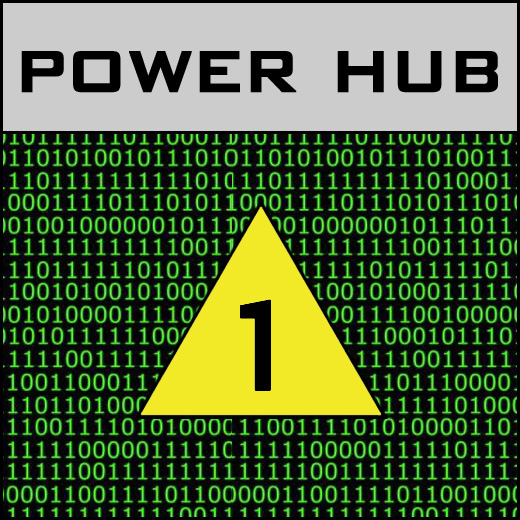
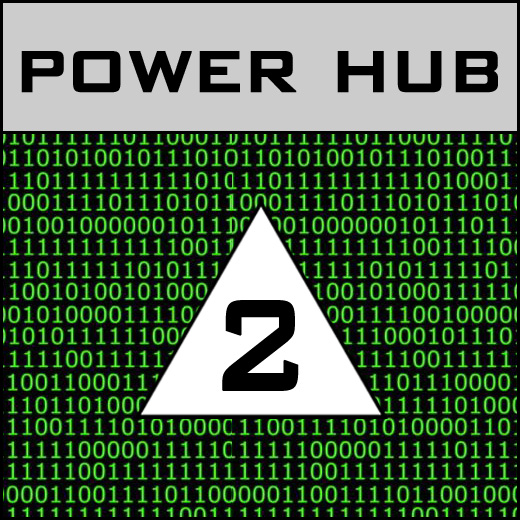
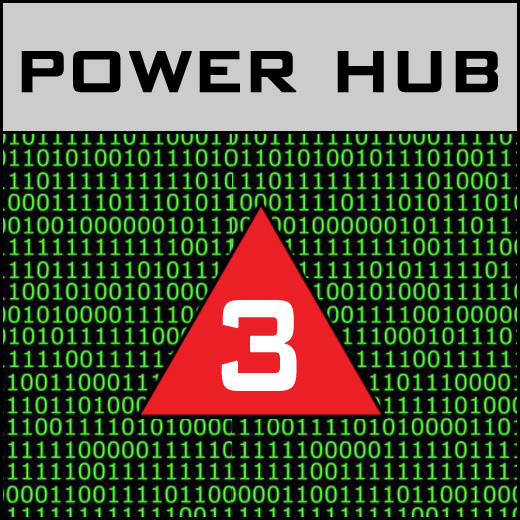
A player who buys a card "Power Hub" constructs a power hub with the capacity to supply as many cities with energy as shown on the card. The red power hub has a capacity of 3, the white one has a capacity of 2 and the yellow one has a capacity of 1.
![]()
Constructing a Power Hub:
A player who buys a card "Power Hub" constructs a power hub with the capacity to supply as many cities with energy as shown on the card. The red power hub has a capacity of 3, the white one has a capacity of 2 and the yellow one has a capacity of 1.
Constructing a Power Hub:
The player positions the card "Power Hub" clearly visible in front of himself and places the pyramid shaped game stone in the corresponding colour on top of it.
 Set the value of the pyramid to value 4 ("no output") to show that the power hub doesn't deliver energy to a city yet.
 As soon as a power hub is built, it is ready to immediately provide energy to cities on the game board that are without power so far.
A power hub gets constructed right after purchase of the card. Therefore no other type of construction can be done within the same round of the game.
Energy Contracts:
As soon as a power hub is built, it begins to deliver energy to all inhabited cities on the game board that are without power so far. The owner of the power hub cannot refuse to supply a city with energy and the owner of a city has to accept the energy delivered.
 A city with energy shows a yellow dot (flip the city stone). Turn the pyramid stone to indicate the number of cities the hub is currently providing with energy.
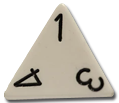 The example image to the left shows the white Power Hub with its maximum capacity of 2 providing 1 city with energy.
Energy contracts cannot be cancelled and are valid until the end of the game. The owner of a power hub and the owner of a city in need of energy may be the same person.
A city with energy shows a yellow dot (flip the city stone). Turn the pyramid stone to indicate the number of cities the hub is currently providing with energy. The example image to the left shows the white Power Hub with its maximum capacity of 2 providing 1 city with energy. Energy contracts cannot be cancelled and are valid until the end of the game. The owner of a power hub and the owner of a city in need of energy may be the same person.
Values of city and Power Hub in VP:
At the end of the game an inhabited city that is connected to a power hub has a value of 3 VP. A power hub's value in victory points equals the number of cities it powers (as indicated on the pyramid).
Competition:
At the end of the game an inhabited city that is connected to a power hub has a value of 3 VP. A power hub's value in victory points equals the number of cities it powers (as indicated on the pyramid).
Competition:
If the number of cities without energy supply exceeds the capacity of a power hub, the owner of the power hub may choose which city or cities to supply.
Likewise, if there are several players with power hubs that are ready to deliver energy, the owner of a city requiring energy may choose the power hub he wishes to connect his city to.
Players who own several Power Hubs may interconnect them with each other.
Once a chip of Omnium is positioned underneath the pyramid stone it cannot be removed at a later time in the game to serve another purpose.
Likewise, if there are several players with power hubs that are ready to deliver energy, the owner of a city requiring energy may choose the power hub he wishes to connect his city to.
Power Grid:
Power Hubs do not only connect to cities, but can be connected to other Power Hubs as well, thus increasing efficiency. At the end of the game the owner of a Hub receives 1 extra Victory point for each Power Hub it is connected to.
To interconnect two Power Hubs each hub requires a chip of Omnium.
Example:
Player A and player B have a Power Hub each. If both players own a unit of Omnium, they can add a "portal" to their respective hubs by putting a chip of Omnium beneath each pyramid stone, thus connecting them with each other.
One portal is sufficient to connect a Power Hub to all other hubs with portals.
Example:
Players A, B and C each own a Power Hub. The Hubs of A and B are already connected via their portals. If player C adds a portal to his hub, it automatically connects with both other Power Hubs.
Once a chip of Omnium is positioned underneath the pyramid stone it cannot be removed at a later time in the game to serve another purpose.
7.) Spaceport:
A player builds the Spaceport:
The spaceport can be built with 5 resource chips of a different colour each.
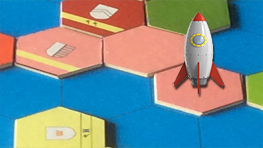
The player who is constructing the spaceport puts the game piece "Spaceport" on one of his undeveloped territories (a territory with no construction on it).
The game ends one round earlier:
Remove the card "Spaceport" from the game.
The game ends one round earlier:
Remove the card "Spaceport" from the game.
As the construction of the spaceport requires all building resources, no other construction can be made in the same round.
At the end of the game the owner of the spaceport receives 1 VP from each of his fellow players for each one of their cities that is connected to a power hub. The Condominium is excluded from this rule as its distinguished inhabitants have no personal need for the spaceport.
The territory with the spaceport cannot be taken over by another player.

Card "Spaceport"
The Government builds the Spaceport:
If the spaceport wasn't built before, then the card "Spaceport" marks the last round of the game when the government intends to buy the required undeveloped territory from one of the players to build the spaceport. Interested players indicate which one of their undeveloped territories they are ready to sell and the Harbour Master sells the card "Spaceport" as usual by hidden auction. Only players who have a suitable territory to offer may take part in this auction.
The winner of the auction receives 3 victory points as payment at the end of the game. Set the game piece "Spaceport" on the territory that was sold to the government, and remove the claim marker. The territory card, however, stays with the seller to prove that he was the former owner.
As the construction of the spaceport requires all building resources, no other construction can be made in this last round. The spaceport cannot be built if no player makes a bid or owns a suitable territory.

terranova.boardgamebbgmailyxcom