


EXPERT RULES 1/3
1.) Setting up the gameAdd the following game cards to the game:
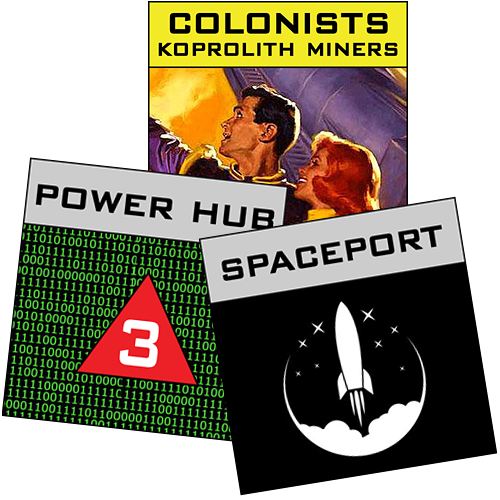
Laying out the Game Cards:
In a game according to expert rules all players can see exactly in which round each specific game card will enter the game: After shuffling the game cards, beginning with the card on top of the stack lay all cards one by one next to each other in clockwise direction around the game board. (See example below)
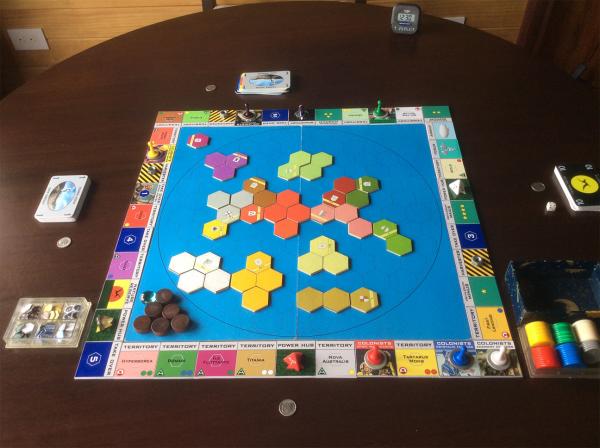
Then place the corresponding game stones on the game cards they belong to:
3 Power Hubs
6 Colonists
1 Spaceport
Add the following game stones to the game:



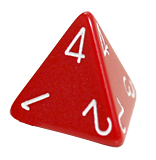
Add the following game stones to the game:
1 Condominium
1 Spaceport
6 Colonist groups
3 pyramid shaped Power Hubs
Laying out the Game Cards:
In a game according to expert rules all players can see exactly in which round each specific game card will enter the game: After shuffling the game cards, beginning with the card on top of the stack lay all cards one by one next to each other in clockwise direction around the game board. (See example below)
Click to enlarge image
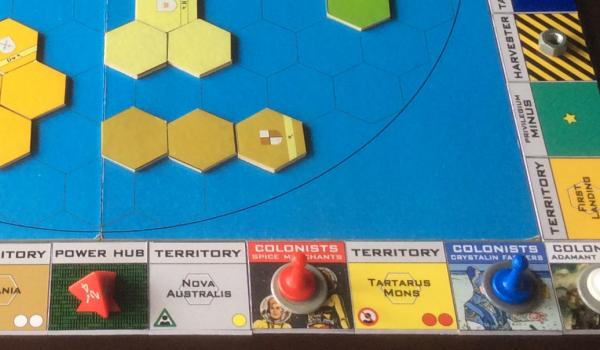
Then place the corresponding game stones on the game cards they belong to:
a) one machine on each game card "Harvester"
b) one chip of Omnium (grey) on each colonist card
c) each colonist game stone on the colonist card that matches its colour
d) each pyramid-shaped game stone on its specific "Power Hub" card.
e) and the game stone "Spaceport" on the card "Spaceport".
Click to enlarge image
The game cards are auctioned off in clockwise direction beginning with the card next to the card "Spaceport" making the "Spaceport" the last card of every game.
2.) Value of Cities:
• At the end of the game the value of an inhabited city is 1 VP (see: "Colonists").
• If a city is inhabited and connected to a power hub it has a value of 3 VP (see: "Power Hubs").
• Add 2 VP if the city is a Metropolis.
• Uninhabited cities have no value.
3.) Colonists
At the end of the game only inhabited cities yield points. Therefore players will try to attract colonists to populate their cities.
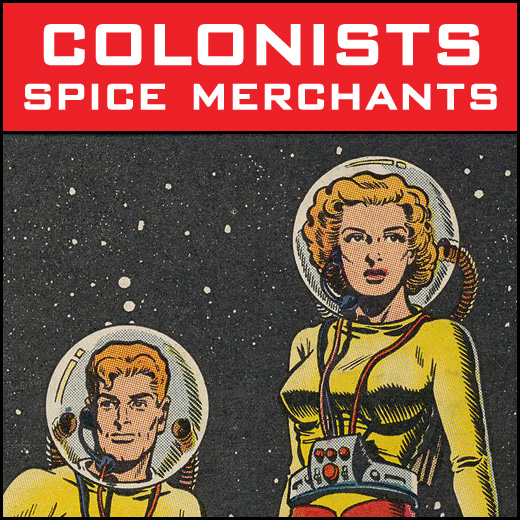
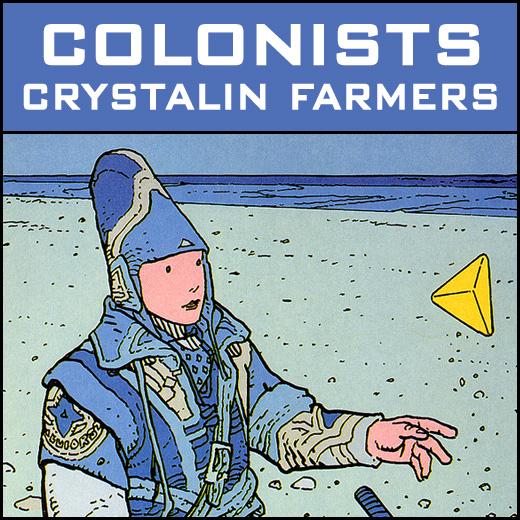
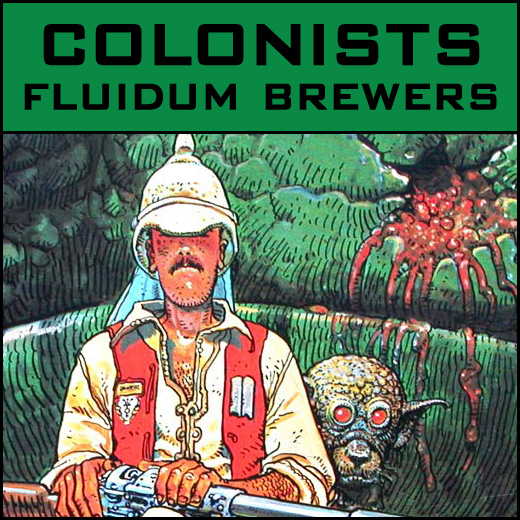
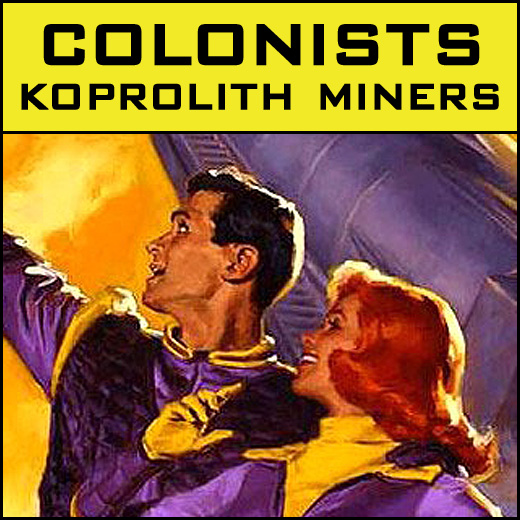
There are 6 colonist cards in the game representing 6 different groups of colonists:

Adamant Cutters
Spice Merchants
Crystalin Farmers
Fluidum Brewers
Koprolith Miners
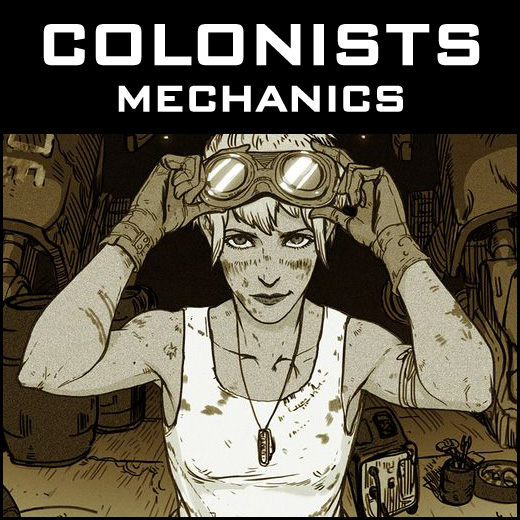
Mechanics
Corporate Executives (Corpex), the 7th group of colonists, enter the game when a player builds the condominium. (see "The Condominium")
Colonist cards are not sold by auction.
Instead, colonists may sign a contract with players who have a territory with the resource the colonists need for their profession. E.g., "Spice Merchants" are ready to join a player who owns a territory with spice, "Koprolith miners" may work for a player having a territory with Koprolith, etc.
Instead, colonists may sign a contract with players who have a territory with the resource the colonists need for their profession. E.g., "Spice Merchants" are ready to join a player who owns a territory with spice, "Koprolith miners" may work for a player having a territory with Koprolith, etc.
One exception are Mechanics (colour black). They are not bound to any specific resource and therefore can sign up with any player who is willing to contract them.
Before contracting colonists:
Remove the colonist card from the game and position the colonist stone on the field "Reception Camp" on the game board.
As long as no player has a territory with the required resource, colonists have to stay in the reception camp of the immigration area (called "Limbo"). The acting Harbour Master keeps his office and the game continues.

Example: Game Stone Koprolith Miners
Competing for colonists:
If several players compete for the same group of colonists, the Harbour Master decides which one of the contenders may contract the colonists. If a player has an uninhabited city he has priority. In case there are several players who can offer the colonists a life in the city, the player with the city that is provided with energy has priority (see "Power Hubs"). In case of a tie the Harbour Master decides, which player may contract the colonists.
Colonists and cities:
As soon as a player constructs a city, his colonists move in to settle there. The player positions the colonist's game stone on the card of the territory where he built the city. Each city offers space for one group of colonists only. If a player has several groups of colonists waiting to be accommodated, he may choose which group moves to the city. Colonists who live in a city gain the status of "citizens" and stay there for the rest of the game.
Overland connections:
An overland connection in a territory with an uninhabited city is to be treated as if the city didn't exist.
Change of Loyalty:
Under the following circumstances colonists will immediately cancel their contract and sign up with another player:
if that other player has:
a) an uninhabited city
if that other player has:
a) an uninhabited city
b) a territory with the type of resource required by the colonists
c) no other group of colonists under contract who could move to that city and
d) is willing to contract them.
The player who accommodates this group of colonists receives the corresponding game stone from the former possessor and positions it on the card of the territory where the newly populated city is located. If there are several cities from different players available to choose from, the Harbour Master decides which player may take over the colonists.
Take over of colonists:
If a player takes over another player's only territory with the resource his colonists require for their profession and these colonists do not live in a city, they move by default over to the new owner of the territory who has to contract them. The new owner of the territory receives the corresponding colonist game stone and places it in front of himself.
However, if other players wish to contract this group of colonists as well, then again, the colonists prefer to live in a city that has energy (see "Power Hubs"). In case of a tie the Harbour Master decides who gets to contract them.
Guild Influence on Territorial Acquisitions:
When a territory is up for auction, the colonist group working with the territory's type of resource will support the player who contracted them: The player receives a bonus of 2 credits to his bid in the auction.
A special case is the support of the Mechanic's Guild: The player who has a contract with the Mechanics receives a bonus of 1 credit to his bids for Harvesters.
Example:
The territory "Aeolis" is for sale. The resource of this territory is Spice. Therefore, if the player who has a contract with the colonist group "Spice Merchants" makes a bid with a credit card with the value 9 his bid has a value of 11 credits. (9 + 2 = 11)Guild Influence without cards:
A players who enjoys a guild's support for obtaining a specific territory can even take part in the auction for this territory without the need to use credit cards. In the example above the player's bid without credit cards had still a value of 1.
.
Possible Disadvantages of having a contract with colonists:
Special colonist relations:
No player can contract the Koprolith Miners AND the Spice Merchants. These two groups refuse to cooperate.
A player who has a contract with one of the two groups cannot take over a territory if he might have to contract the other group as a consequence. Neither of the two colonist groups will move to a city of a player who has a contract with the other group.
A player who has a contract with one of the two groups cannot take over a territory if he might have to contract the other group as a consequence. Neither of the two colonist groups will move to a city of a player who has a contract with the other group.
The risk of contracting too many colonists:
At the end of the game each group of colonists who doesn't live in a city by then is dissatisfied. The result is social unrest, costing the player who contracted them 1 Victory Point per affected colonist group.

terranova.boardgamebbgmailyxcom